
Crochet book keychain pattern is a charming project that transforms a small amount of yarn into a miniature handmade book that can decorate keys, backpacks, handbags, pencil cases, or craft bags.
Another advantage of this Crochet book keychain pattern is the opportunity to experiment with colors and leftover yarn.
The construction in this Crochet book keychain pattern uses basic stitches, including chains, single crochet, and slip stitches, along with straightforward assembly techniques. Beginners who already know how to hold a crochet hook, create a foundation chain, and work single crochet stitches should be able to follow the project carefully. More experienced crocheters can customize the miniature book by adding embroidered initials, decorative borders, a tiny bookmark, contrasting pages, or other small details. Before starting, gather your materials, read the complete instructions, and become familiar with the crochet abbreviations so that every stage of the project feels organized and enjoyable.
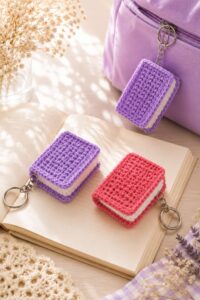
Materials, Crochet Keys, and Preparing the Mini Book
For this Crochet book keychain pattern, you will need approximately 20 to 30 yards of lightweight cotton or cotton-blend yarn. Choose one main color for the cover and a smaller amount of cream, beige, or white yarn for the pages. You will also need a 2.75 mm to 3.5 mm crochet hook, scissors, a yarn needle, stitch markers if desired, and a small metal keychain ring or lobster clasp. The exact hook size can be adjusted according to your yarn and tension.
Understanding the crochet keys will make the instructions easier to follow. This pattern uses standard US crochet terminology: ch = chain, sc = single crochet, sl st = slip stitch, st = stitch, sts = stitches, RS = right side, WS = wrong side, and FO = fasten off. The majority of the miniature book is made with single crochet because this stitch creates a compact texture that helps the small pieces maintain their rectangular shape.
To make a chain (ch), begin with a slip knot on your crochet hook. Yarn over and pull the yarn through the loop already on the hook. Repeat this movement until you have the required number of chains. Try to keep every chain approximately the same size. Uneven foundation chains can make one side of a miniature rectangle appear longer or tighter than the opposite edge.
For a single crochet (sc), insert the hook into the indicated stitch, yarn over, and pull up a loop. You should now have two loops on your hook. Yarn over again and pull through both loops. When working on such a small crochet book keychain, maintaining consistent tension is particularly important because even small variations can noticeably affect the shape of the finished pieces.
A slip stitch (sl st) is made by inserting the hook into the indicated stitch, yarning over, and pulling the yarn through both the stitch and the loop already on your hook. Slip stitches are useful for joining small sections and creating neat decorative edges. They can also help reinforce the point where the keychain loop connects to the miniature book.
Gauge is flexible for this Crochet book keychain pattern, but your crochet fabric should be relatively firm. Loose stitches may make the miniature book floppy and reduce the definition of its shape. If your fabric has large spaces between stitches, consider using a slightly smaller crochet hook. The finished book in this tutorial should measure approximately 2 to 2.5 inches tall, although the final size will vary according to yarn weight, hook size, and individual tension.
Step-by-Step Crochet Book Keychain Pattern
Begin the cover of your Crochet book keychain pattern using the main yarn color. Make ch 9. Starting in the second chain from the hook, work 1 sc in each ch across (8 sc). Turn your work. For Row 2, make ch 1, which does not count as a stitch, then work 1 sc in each st across (8 sc). Turn again while keeping the edges straight.
For Rows 3–12, repeat the following sequence: ch 1, 1 sc in each of the 8 sts across, turn. At the end of Row 12, you should have a small rectangular piece. This rectangle will eventually fold around the interior pages and become the front cover, spine, and back cover of the miniature book. If the rectangle seems too narrow for your desired proportions, you can add one or two additional rows.
After completing the final cover row, FO and leave a yarn tail approximately 8 inches long. Place the rectangle flat and gently straighten the edges with your fingers. Fold it approximately in half to identify where the spine will be located. Do not permanently sew the fold yet because the crocheted pages need to be created and positioned inside the cover first.
Now change to cream, white, or beige yarn for the pages. Make ch 8. Beginning in the second chain from the hook, work 1 sc in each ch across (7 sc). Turn. For Rows 2–10, make ch 1, 1 sc in each st across (7 sc), turn. This creates the main interior page panel. The page rectangle should be slightly smaller than the cover so that the colored outer edge remains visible.
After Row 10, FO and leave a long tail for assembly. Fold the page rectangle in half and place it inside the folded cover. Check the proportions before sewing. The cream-colored pages should remain slightly inside the outer edges of the cover rather than extending beyond them. If your page panel is too large, gently adjust its position or remake it with one fewer foundation chain.
Thread the long yarn tail from the page panel onto your yarn needle. Position the center fold of the pages directly against the center fold of the cover. Sew vertically along this fold using several secure stitches, joining the pages to the cover and simultaneously defining the book spine. Tie off securely and weave the yarn ends into the interior stitches where they will be less visible.
Assembly, Keychain Loop, and Creative Details
Once the main sections of the Crochet book keychain pattern are assembled, gently open and close the miniature book to check its shape. The cover should extend slightly beyond the page section, creating a recognizable book-like silhouette. Use your fingers to straighten the corners and define the central spine. Small adjustments at this stage can significantly improve the finished appearance.
To make the hanging loop, attach the main cover yarn near the upper corner of the spine. Make ch 8, then bring the chain back toward the starting point and secure it with a sl st. Work one or two additional slip stitches into the base of the loop for reinforcement. FO and weave the yarn tail securely into the cover. The loop should be large enough to accommodate your chosen keychain hardware.
Open the metal keychain ring carefully and slide the crochet loop onto it. If you are using a lobster clasp, connect the clasp directly through the loop. Test the connection gently before attaching keys or placing the accessory on a backpack. Since the hanging loop receives more stress than other parts of the project, reinforcing it carefully is important for long-term durability.
You can personalize the front of the crochet miniature book with simple embroidery. Use contrasting yarn and a yarn needle to create a small letter, heart, star, line, or geometric symbol on the cover. Because the surface is tiny, simple designs usually look clearer than complicated ones. Embroidering the decoration before permanently assembling the book can make this step easier.
Another decorative option is adding a miniature bookmark. Cut a short piece of thin contrasting yarn and secure one end near the top of the spine between the cover and pages. Allow the remaining yarn to extend slightly beyond the bottom of the book. A red, gold, or contrasting bookmark can add an especially charming detail while requiring almost no additional crochet.
Color combinations can completely change the personality of this Crochet book keychain pattern. Brown and cream can create a vintage-inspired appearance, while dark blue and white produce a classic combination. Burgundy with beige pages can resemble an old hardcover book, while pink, lavender, yellow, or turquoise can create a cheerful accessory. You can even make several miniature books in different colors and use them as coordinated bag decorations or handmade gifts.
Customization, Troubleshooting, Care, and Useful Tips
Choosing the appropriate yarn makes a significant difference in a miniature project. Cotton is an excellent choice for this Crochet book keychain pattern because it generally provides strong stitch definition and enough firmness to maintain the rectangular shape. Cotton blends are also practical. Acrylic yarn can be used, although softer acrylic varieties may create a more flexible book that requires additional shaping.
If your miniature book looks too loose or floppy, try using a smaller hook. Dense crochet fabric creates stronger covers and more defined corners. However, avoid working so tightly that inserting your hook becomes uncomfortable. The ideal tension should produce compact stitches while still allowing the hook to move smoothly through every stitch.
If your crochet rectangle becomes narrower as you work, you may be accidentally skipping the first or last stitch of some rows. Count your stitches frequently. The cover should maintain 8 sc per row, while the page panel should maintain 7 sc per row according to this tutorial. Consistent stitch counts are one of the easiest ways to achieve straight edges.
You can modify the dimensions of this Crochet book keychain pattern without changing the fundamental construction. To make a larger book, increase the number of foundation chains and crochet additional rows. Remember that the cover needs to be slightly larger than the interior page panel. Maintaining this difference creates the visible border that makes the project resemble a real hardcover book.
For cleaning, follow the care recommendations for the yarn you selected. Keychains are frequently handled and may eventually collect dust or surface dirt. Gentle hand washing can be appropriate for many cotton yarns. Avoid aggressively twisting the miniature book after washing because this could distort its rectangular shape. Instead, gently remove excess moisture and allow the piece to dry flat.
This pattern is also an excellent scrap yarn crochet project. Very small quantities of leftover yarn can become covers, pages, bookmarks, borders, or embroidered details. Rather than discarding short remnants from larger projects, organize them by color and use them to create a collection of miniature books. Each one can have its own cover design and personality while following the same simple construction.
Frequently Asked Questions About Crochet Book Keychain Pattern
Is the Crochet book keychain pattern suitable for beginners?
Yes. This project primarily uses chains, single crochet, and slip stitches. Beginners who understand these basic techniques can follow the pattern carefully. The assembly requires some hand sewing, but the construction is straightforward and provides useful practice with finishing small crochet projects.
What yarn should I use for a crochet book keychain?
Lightweight cotton or cotton-blend yarn is a practical choice because it creates defined stitches and relatively firm fabric. Medium-weight yarn can also be used, although it will produce a larger and thicker miniature book.
How much yarn do I need?
Approximately 20 to 30 yards should be sufficient for the complete project. You will need more of the main cover color and a smaller amount for the pages and optional decorative details.
What size crochet hook works best?
A hook between 2.75 mm and 3.5 mm works well with many lightweight yarns. The correct hook depends on your yarn thickness and personal tension. Choose a size that produces firm fabric without making the stitches uncomfortable to work.
How large is the finished book?
Using the suggested materials, the finished miniature book should measure approximately 2 to 2.5 inches tall. Your dimensions may differ slightly according to yarn, hook size, and tension.
Can I make the miniature book larger?
Yes. Increase the foundation chains and add additional rows to both the cover and page panels. Always make the cover slightly larger than the interior pages so that the final project maintains realistic book proportions.
Can I add more crochet pages?
Yes. You can make additional small page rectangles and sew them together along the central spine. Keep in mind that adding too many layers can make the miniature book bulky, so lightweight yarn is particularly useful for multi-page versions.
Why are my crochet edges uneven?
Uneven edges commonly result from accidentally adding or skipping stitches. Count every row carefully and identify the first and last stitch before crocheting across. Using a stitch marker can help beginners identify edge stitches.
Can I make this project without keychain hardware?
Absolutely. Without the metal ring, the miniature book can become a small ornament, bag decoration, gift embellishment, doll accessory, or decorative craft element.
How can I personalize the book cover?
Use embroidery to add a small initial, heart, star, flower, or simple line design. You can also use contrasting slip stitches around the cover edge or create stripes by changing colors during the crochet process.
Can I add a bookmark?
Yes. Secure a short piece of contrasting yarn near the top of the spine and allow it to extend slightly below the pages. This tiny detail can make the finished crochet book look even more realistic.
Why does my miniature book curl?
Curling may occur when crochet tension is too tight or uneven. Try using a slightly larger hook or relaxing your tension. Gentle blocking can also help flatten the individual rectangles before assembly.
Should I block the pieces before sewing them together?
Blocking is optional but can improve the shape, especially if the rectangles curl noticeably. Use a blocking method appropriate for your yarn fiber and allow all pieces to dry completely before assembly.
Is this a good project for leftover yarn?
Yes. A Crochet book keychain pattern requires only small quantities of yarn, making it particularly useful for scraps remaining from larger crochet projects. Different leftovers can be combined to create unique covers, pages, and decorative details.
What else can I use the finished crochet book for?
Besides using it as a keychain, you can attach it to backpacks, handbags, pencil cases, craft bags, or zipper pulls. It can also become a small handmade gift for teachers, students, readers, librarians, writers, or anyone who enjoys book-inspired accessories.
Conclusion
Creating a Crochet book keychain pattern is a fun way to combine simple crochet techniques with a charming miniature design. Throughout this tutorial, you learned how to prepare the necessary materials, understand essential crochet keys, crochet the rectangular cover, create the interior page panel, assemble both sections along the spine, and make a reinforced loop for the keychain hardware.You also learned several ways to personalize the project, including choosing different cover colors, adding embroidery, creating a tiny bookmark, changing the dimensions, and adding extra page sections. These simple variations make it possible to create many different miniature books while using the same basic construction method.
Because the project requires very little yarn, this Crochet book keychain pattern is also a practical way to transform leftover materials into something useful and decorative. The finished miniature book can decorate keys, backpacks, handbags, pencil cases, craft bags, or gifts, while customized versions can become thoughtful handmade presents for people who love reading and crochet.
If you make this crochet book keychain, please leave your sincere opinion about the pattern and share your suggestions. Tell us which cover colors you would choose, whether you would add a bookmark or embroidered decoration, and what creative changes you would make to the design. Your ideas and feedback can inspire even more unique versions of this small handmade crochet project.